

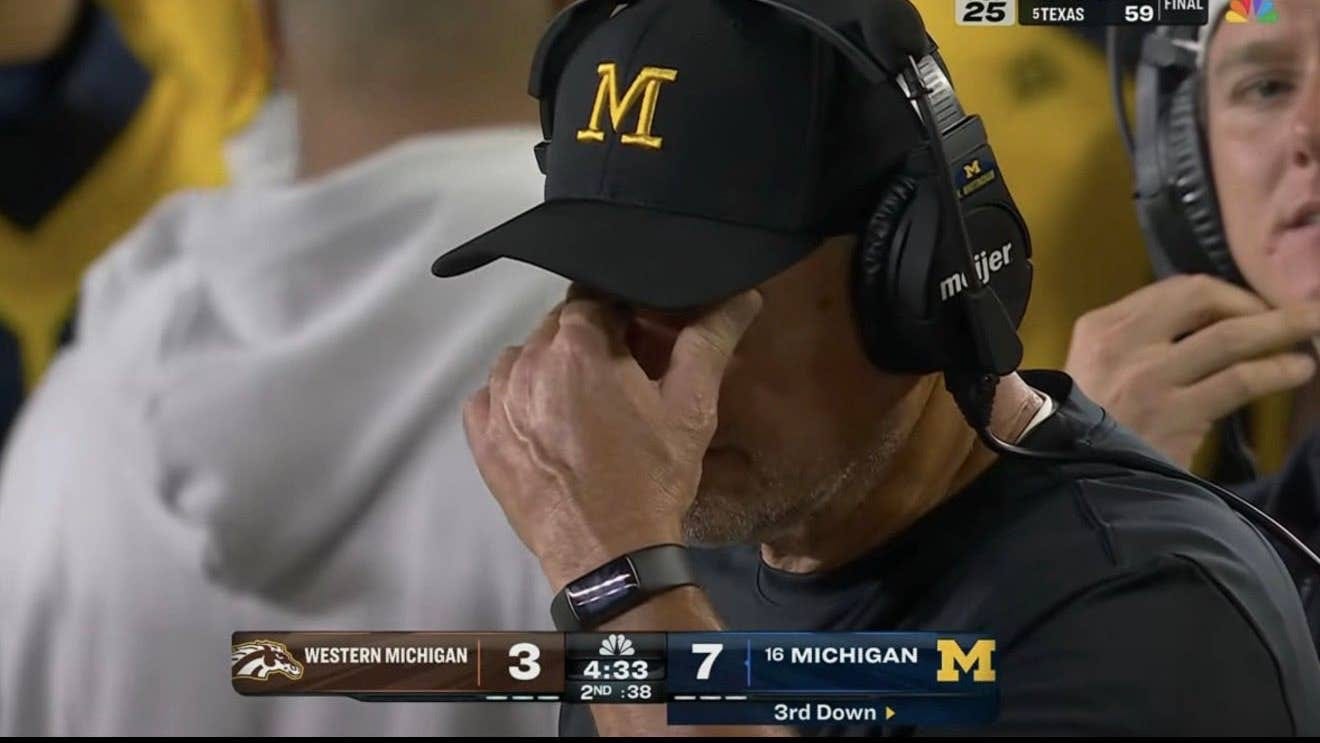
Michigan’s inexplicable 13-12 hail Mary win over Western Michigan set off a firestorm of tiny brained conspiratorial thinking, perfectly demonstrating the human incapacity to accept randomness and imperfection as the explanation for external stimuli we don’t like.
The play on which Michigan won, a 47-yard pass from Bryce Underwood to JJ Buchanan that was equal parts remarkable and stupid1, came with one second left on the clock. It was preceded by an incomplete Hail Mary pass that started with nine seconds on the game clock and ended with triple zeroes.
Normally this would end the game, but the officials put one second left on the clock after a review because they determined the play ended2 with one second left on their game clock, which is different from the clock on the stadium’s scoreboard which is also different from the clock on your TV screen.
In other words, this was when the play ended according to the three clocks in play:
The game clock NBC put on your TV: 0:00
The game clock on the stadium score board: 0:00
The game clock the officials use and is the only game clock that actually matters: 0:01
It’s no surprise that these clocks are not in sync. They have different operators and organized football refuses to use tenths of a second as a measuring stick, which would make it easier to sync. Even if they did use tenths of a second, the incomplete Hail Mary play has been timed by various internet posters as coming in at the range of 8.3 to 8.4 seconds. If tenths of a second were used, then, we would have seen that there was more than half-a-second left to play.
The fact these clocks aren’t in sync came no surprise to me because I’ve been following this sport closely for over a decade now, and broadcasters are typically quick to point out that their TV clock is different from the official clock. Pouring fuel on the conspiracy fire, though, NBC’s broadcasters took the bizarre step of insisting on air that their clock was properly in sync.
This, of course, is irrelevant to evaluating this particular situation. It feels like Western got robbed. But rather than recognize that feeling is the result of randomness and football’s insistence on unclear and difficult to explain rules, internet posters and some boneheaded members of the increasingly stupid sports media, are insisting or implying that Michigan’s win is the result of a conspiracy. This position is ridiculous on its face and not worth illustrating even for rhetorical purposes.
The first counterpoint to it comes from Western Michigan president Russ Kavalhuna on the different clock situation between broadcast and replay command:
“It was just a discrepancy. I would just say that what the viewing public see and what the reviewing officials see are different and that's clear. I've looked into this pretty closely, and I used to be a federal prosecutor. I don't discern anything unfair or untoward in this process. Can the process be improved by having what the viewing public see as the same as what the reviewing officials see? Maybe. Frankly, that's not for me to decide.”
Kavalhuna is certainly correct that there needs to be more transparency; the proliferation of sports gambling puts too much money at stake for this type of organizational stupidity.
The response from the chorus of tinfoil hats is to point out that Western receives a sum in the low nine-figures to play teams like Michigan. It is not in the financial interest of a struggling financial college team to rock the boat. Kavalhuna’s quote refuting the conspiracy, then, is just further evidence of the conspiracy.
Let’s say that there is a conspiracy, that the officials were trying to fix the game so that Michigan could win. They did a very poor job of doing that. In the words of one attorney-by-day-Michigan-blogger-by-night writer:
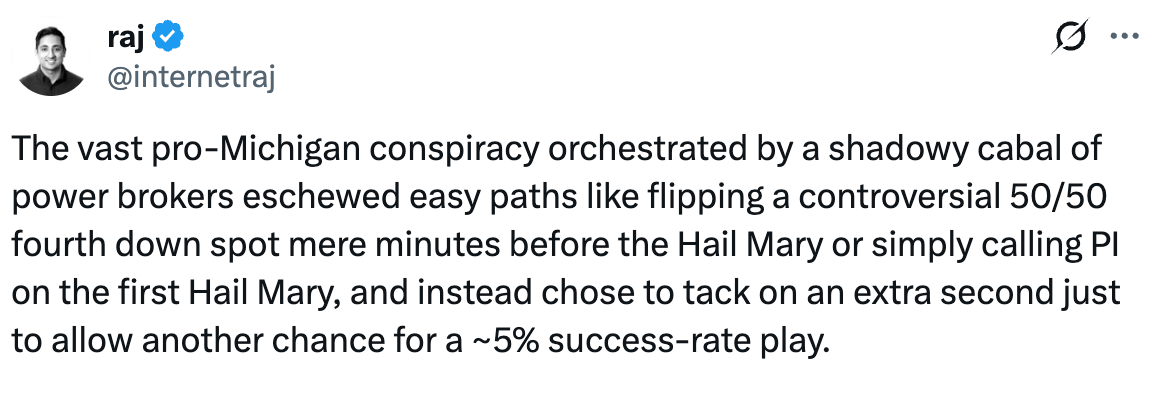
This is the problem with conspiratorial thinking. The shadowy cabal is always simultaneously all powerful and in control of things there’s no actual way for them to be in control of (e.g.: the weather or JJ Buchanan having good hands), and yet they are also deeply and self-evidently incompetent.
At the end of the day, there’s little point to arguing about whether or not there is a conspiracy. You cannot argue away what is an intellectual and emotional defense mechanism.
A 2023 journal article highlighted by the American Psychological Association analyzed data from 170 studies involving over 150,000 participants and found that people were motivated to believe in conspiracy theories for two primary reasons:
To understand and feel safe in their environment and
To feel like the community they identify with is superior to others.
It is easier and feels better to believe that you live in a world in which bad things happen for a reason rather than happenstance. To think otherwise is to admit a lack of control that is scary. It implies that a bad thing can happen to you at any moment for any reason, but if there is a conspiracy in charge, that implies there is order and control, something to be wrestled with—that there is a PlayStation control which simply needs to be put into the right people’s hands, people like you, the good and righteous person. But power is like sand. It slips through your fingers. Human society is too large and messy to be controlled by any force, let alone a shadowy cabal. Think about it. We can’t even get the right clock on your TV.
The second point is also easy to observe in this instance. Many a sports hater—the type of people who condescendingly call it “sportsball” and then turn toward something they deem more intellectual like playing atonal jazz on a detuned oboe—like to point to sports as a past time where meatheads claim superiority over other meatheads on the basis of games played by even more meatheads. What better way to invalidate a meathead’s claim to superiority than by saying that they only won by cheating?
I could go on but I am beginning to feel dumber for having spent any time addressing a conspiracy theory like this one, a pointless emotional hurricane perpetuated because it makes people mad, which makes people comment on internet videos of people being mad, which drives more traffic to the internet videos of people being mad, which generates more ad revenue.
What we should be talking about is how well Western played. They were a disciplined, motivated unit who perfectly executed a well-designed, take-the-air-outta-the-ball game plan that would have worked had Michigan not gotten extremely lucky. Scott Van Pelt sarcastically commented that “Western signed up to play 60 minutes” and that’s what they did. They were better team for 60 minutes. They also lost because in football, as in life, their is no guarantee that superior effort will be rewarded. Se la vie, se la football.
The Wolverines, meanwhile, will have to go back to the drawing board and radically reconsider their approach to offense. The new staff inherited a team that was very good at one thing—inside zone running—but they seem to insist on building a run game around outside zone and sweeps. The only thing dumber than that is believing a man in a smoke filled room picked up a phone and said, “put one second back on the clock.”
Bryce Underwood was backpedaling in the pocket both because his line could not protect him and because he is constitutionally incapable of moderating his throwing power. JJ’s catch was a pretty incredible display, though, I have to admit.
The play ended the instant a Western player who was out of bounds touched the ball, which I would have thought would have resulted in an illegal touching penalty but for some reason that hasn’t come up.